
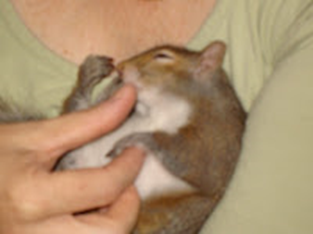
Who knew a squirrel could be cuddly?


During Vacation Bible School at my church recently, to inspire everyone to dig deep into their piggy banks and support our designated mission project, I invited a local animal rescue organization to bring some of their critters and talk about their work.

To say that the ladies who came made an impression would be an understatement. The children were mesmerized by the chance to see and touch a sugar glider, raccoon, and squirrel up close, and we adults turned into big puddles of mush--begging to hold and cuddle these wild things that fate has domesticated. (Okay, calling Buddha the Raccoon "domesticated" would be a stretch, but he was amiable and accommodating, if not docile!) Hazel the Squirrel, brain damaged at an early age due to a fall from her nest, was an angel, happily nibbling nuts from our palms and snoozing contentedly on our shoulders. Splenda the Sugar Glider was cordial and curious but, being nocturnal, fell asleep and pretty much missed the party.

While we ogled and petted and cuddled these animals that were fortunate enough to be rescued from their sundry disasters, the rescue reps shared staggering statistics and sobering stories: the fifteen volunteers of their organization took in 11,500 injured, abandoned, abused, or endangered animals from nine different counties last year. (Do the math: that's almost 770 animals A PIECE--2 a day, every day for a year!) So where do these animals come from? Sometimes they're exotic pets that people get bored with or tired of. Sometimes they wander into dangerous or inappropriate places and someone calls for help. Sometimes a neighbor reports another neighbor who's tried to turn a wild thing into a pet. Sometimes someone sees an animal being abused and asks the rescue team to intervene. Sometimes a park ranger calls to say "the mama's dead and we have no way to take care of the babies." So off goes the rescue team, superhero saviors of the furry and the four-footed. Of course, these volunteers don't just show up, save the day, and drive away; many times they take these animals into their homes and nurse them back to health, give them a home until one can be found, or care for the animal until it can be released back into the wild.

Did I mention that these are volunteers? As in, they offer up their time, gas, resources, and homes for FREE, with no compensation whatsoever, purely because they have hearts made of solid gold? We were happy to bestow a week's worth of Bible school donations on them, but what we gave doesn't even begin to make a dent in what they need. So if you'd like your hard-earned money to go to something besides the gas pump for a change, toward something that is human kindness of the purest kind, consider sending a few dollars to support your local animal rescue effort. (And, yes, even a few dollars really helps!) If you can't spare cash, consider giving some time or supplies; these organizations are always in need of runners, clerical help, vet services, food, etc.

It's getting harder and harder to make a difference in today's world; here's an opportunity that's guaranteed. Buddha and Hazel thank you!

Remembering June in May


Who’s your favorite mother? Well, besides your own, of course. Or maybe you always wished you had the mom down the street instead of the one God gave you—the one that let her kids come and go as they pleased, never issued all those pesky rules and ultimatums, and was SO much cooler.

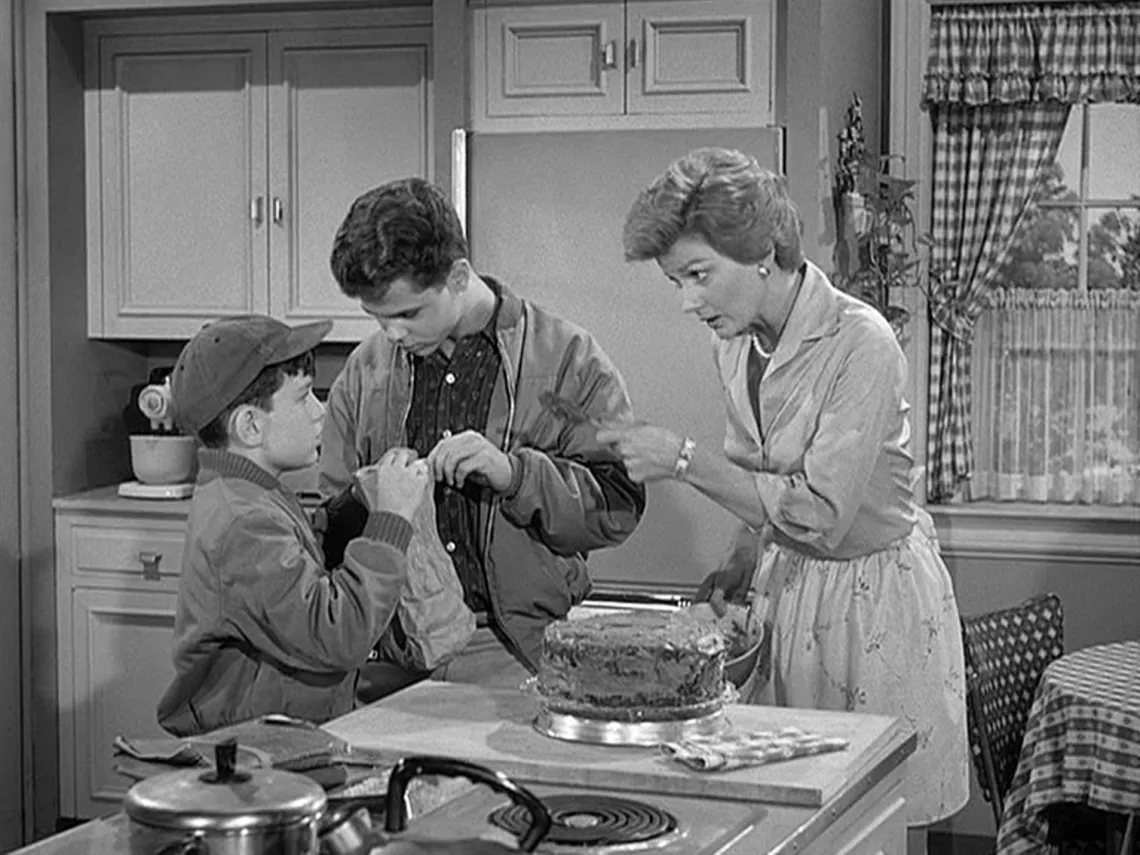
While I greatly admire the wise and wonderful Marmee from Little Women , I must confess that my favorite mom is June Cleaver. A fellow mother of sons, June offered the perfect blend of intelligence, humor, assertiveness, skepticism, modesty, graciousness and spunk. During all those years when I watched faithfully every week as Mrs. Cleaver capably dealt with crisis after crisis, I had no idea I’d have a Beaver and Theodore of my own someday. Thankfully, my days as a mom never brought forth an Eddie Haskell or a baby alligator to deal with; even so, I feel certain my sons benefited from lessons my subconscious surely retained as I watched June carry out her role as Arbiter of Domestic Harmony without ever breaking a sweat.


In contrast, my own mother sweated a lot to keep me on the appropriate path to adulthood. Working in the yard was always her favorite way to reduce stress; let’s just say our yard looked TERRIFIC during my teenage years! While our living room looked just like the Cleavers', our confrontations weren’t nearly as polite--and occasionally involved a ruler, flyswatter, or switch to help focus my attention. Because I loathe confrontations and learned early the power of words, my favorite battle tactic was to leave a note on Mother’s pillow detailing her horribly unfair assessment of my sin du jour, her ridiculous overreaction, and the depth to which her wrath had grievously wounded me. It’s too bad she didn’t save any of those notes; they would have made great reading all these years later.

I worry about the moms we’re watching on TV and in movies today. Are they instilling/demonstrating essential traits such as honesty, compassion, and integrity? Self-respect and self-control? Do the Real Housewives of Wherever even know those terms? And if new generations aren’t being taught basic values, where exactly is civilization headed?

Be proactive this month: tell a good mom she’s worth a lot more than she realizes. And next time you vacuum, put on your pearls; maybe June knew something we don't.


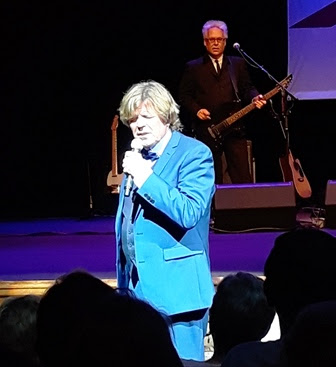
In a recent conversation with one of my Millennial sons, I made a reference to Herman’s Hermits. He was clueless. “You know, “I-I-I-m ‘enery the eighth, I aaaam…” I intoned. He shook his head. “There’s a kiiind of hushhhhhhhhh…?” Blank stare. Having thoroughly enjoyed Peter Noone and the current Hermit line-up in concert a couple of years ago, I felt a pang in my heart that my child knew NOTHING about those great songs. A few days later, listening to the ‘50s channel on Sirius XM in my car with another son, the Spaniels’ “Goodnight, Sweetheart” came on. “This is such a great song!” I sighed in pleasure. “Never heard it,” came the response.

Now, as a mother, exposing my children to different types of music was very important to me. I thought I’d done a good job—my youngest does a rousing rendition of “Up from the Grave He Arose,” my middle is pondering season tickets to the Charlotte symphony, and my oldest bought me a Mills Brothers CD for my birthday—but, that day, it occurred to me that we Boomers are blessed with a much broader musical horizon than any other generation. We grew up with that fabulous music of the ‘50s, ‘60s, and ‘70s. Those of us with older parents had the privilege of knowing music from the ‘40s, as well. What a gift to have four decades worth of incredible mood-lifting, finger-snapping, soul-touching, memory-marking tunes readily accessible in the jukebox of our brains!

So, for all the grief we Boomers are dealing with as we move from middle age into old age, comfort yourself with this thought: there’s not an arthritic hip, a bum knee, a cataract, or a foggy brain that can’t be perked up with the amazing music of our generation. Turn up your hearing aid and rock on!

Life Moments: May 2nd

 Things That Made Me Smile Today:

1. Waking up to discover that my rose garden went from 2 to dozens overnight!

2. A dog that smiled at me from the back seat of a truck. (The window was down.)

3. Lunch with my sister and two good friends. One of them is about to turn 90 and tells THE funniest jokes.

4.Listening to Pat St. John on Sirius '60s Gold. (He always makes me smile.)

Things That Annoyed Me Today:

1. An urgent care center marquee that is still advertising an event from October. Hello??? Doesn't anybody who works there ever read the sign?

2. The idiot who pulled out in front of me, made me slam on my brakes not to hit him, and then made a left turn 100 feet later.

3. The rude person who stayed thisclosetomybumper on a residential street where the speed limit was 35.

Can this be the year of kindness?


I've just finished reading Wonder, by R. J. Palacio. I highly recommend both the book and the movie by the same name. The order doesn't matter; both are excellent and proved to be a perfect note on which to start a new year.

A central theme throughout the story is kindness, a trait that has been sorely absent in our world for some time now. As I devoured page after page about August Pullman's family, friends, and feelings, I was pleased to come across a little poem generally attributed to John Wesley among the "precepts" (defined as "rules about really important things") presented by August's fifth grade English teacher:

"Do all the good you can
By all the means you can,
In all the ways you can,
In all the places you can,
At all the times you can,
To all the people you can,
As long as ever you can."

It struck me that this is the goal toward which all of us should aspire in this fresh, new year. Face it: there is little we can do individually about hunger, violence, disease, human trafficking, or the hundreds of other issues with which political leaders across the world must struggle every day. But we can do a lot in our own tiny circle of existence if we consciously make a choice to consistently do the good thing, the wise thing, the generous thing, the kind thing.

I am making a pledge to myself to try and heed Rev. Wesley's admonition on a daily basis in 2020. Will I fail? Undoubtedly. But I just might tip the scale toward something positive--and I like the thought of that.

The Return of the Generation Gap—in the Grocery Aisle

Today's generation gap isn't centered around music (much to their chagrin, I quite like most of the bands my sons listen to); it's centered around food. In a recent survey done by The Institute of Grocery Distribution, statistics show that shoppers under 35 are twice as likely to want organic food as those over 35, and a third of them don't mind paying more for it. Those under 35 are also more likely to waste less food, cook from scratch, and base their food purchases on a company's reputation for social responsibility. 

Having read Michael Pollan's riveting and enlightening book, The Omnivore's Dilemma, my eyebrow inevitably quirks any time I read a product's proud proclamation as "Organic!!!" (though I've recently conceded that if I'm planning to eat the peel on a fruit or vegetable, perhaps it really is worth paying for the chance it might actually be pesticide-free). Meanwhile, my 29-year-old's silent stares of recrimination when he's with me in the produce aisle are such that—at least when he's around—I find myself picking up organic more and more. In fact, the changed eating habits of my three sons—all under 36— have changed my own grocery buying habits dramatically. Gone are the white bread, soda, chips, cold cuts, and sugary cereals they loved in their youth. Now they ask for brown rice, dried beans, sweet potatoes, oatmeal, whole grain pasta, and Brussels sprouts. Yes, Brussels sprouts.

How is it that a generation raised on Pop-Tarts, Red Bull, and sundry processed foods has suddenly discovered their inner Euell Gibbons? These are children who grew up with 2XLs and Furbies, not Easy-Bake Ovens—children who ate more meals in back seats than at dinner tables because their parents were always working or on the go. That 29-year-old who now sneers when I reach for sugar instead of raw honey was the "Taco Bell Kid" until his passion evolved from burritos to bicycles a few years back.

But all this purity is a good thing, surely—and not just for those farmers wily enough to grab on to a USDA label. (Go for it, guys; you farmers deserve any break you can get.) Certainly there's enough evidence now to convince us that homemade whole wheat bread is healthier than a loaf of Sunbeam, that snacking on a fresh apple from a local orchard is a better choice than French fries from a local McDonald's. And how can you fault a mom who works all day then comes home and willingly makes kale and goat cheese calzoneswith tomatoes and basil from a backyard garden, no lessinstead of whippin' it through the Pizza Hut drive-thru?

No, I'm quite willing to let the Millennials lord their superior nutritional standards over us Boomers, because while I will never feel the need to apologize over serving up a cake that started with a box from Duncan Hines, I readily admit that Happy Cow un-homogenized whole milk, with no additives, from [happy!] grass-fed cows, is significantly better than ye olde mass produced 2% and worth the price difference. Meanwhile, it's pressure (read: guilt) from my own 3 Millennials that has reduced my soft drink consumption to almost nil, my fast food meals to a minimum, and my love affair with white food to the occasional crush. For that, I credit them (and say a heartfelt thank you) for a healthier body and a hefty weight loss.

I'm not quite ready to jump on the tofu wagon or give up Coke completely, but if this generation wants to raise their own chickens, bake their own bread, grow their own fruits and vegetables or insist on buying what goes into their bodies from someone they know instead of from Monsanto, who are we to stand in their way?

Respecting those choices is the least we can do after raising them on Pop-Tarts and Tang.


Is Encouraging Entrepreneurship the Solution to Unemployment?

The man in the middle is my dad. He started a Western Auto franchise in a tiny little town in central Florida and won one top sales award after another. He loved his employees and they loved him!


Did you know this is Small Business Week? Sponsored by the U.S. Small Business Administration since 1963, this annual celebration of the foundation of the American economy is a great time to consider a few facts you might not know:
  • More than half of Americans either own or work for a small business.
  • Small businesses create 2 out of every 3 new jobs in the U.S. each year. From the end of the recession (mid-2009) through mid-2013, small businesses were responsible for 63% of the net new jobs.*
  • From 2002 to 2012, self-employment among young people age 25 and under decreased by 23%. In that same time period, self-employment among senior adults 65 and over increased by 66%.
I'll come back to that last bullet point in a moment but, in the meantime, if you think big business is where big ideas come from, think again: a 2008 study** from the SBA’s Office of Advocacy found that small companies are much more likely to develop emerging technologies than are large ones. Plus, small business owners have a strong interest—and an active voice—in economic and political affairs: a whopping 95% are registered voters and 84% vote on a regular basis. Small business owners put their money where their mouth is, too: 91% of them routinely volunteer for, and donate to, nonprofit and community organizations.

So why, when small business is the proven backbone of this country, have we made it so ridiculously hard to start one? Even if they can figure out what licenses have to be obtained, what forms need to be filed, what regulations must be adhered to, and what taxes need to be paid, what small business owner has time to DO all that when he or she is likely working 70-80 hours a week to get that new business off the ground? And how’s he supposed to pay for all those licenses and taxes when he’s barely generating enough to stay afloat in those early days?
Let’s go back to that last bullet point. We know why seniors are starting their own businesses—they can’t afford to retire and just sit on the porch—but why the decline in entrepreneurial efforts among young people? I’m thinking it’s because there’s so much red tape and so many roadblocks, which is a crying shame because it seems to me that starting their own business would be an ideal way to get unemployed young men in our urban areas off the streets and into a productive lifestyle. Seems to me big cities with big crime problems, big drug problems, big gang problems and other issues that seem to center around big numbers of idle young males would do well to offer free classes in entrepreneurship then do whatever they can to help these fellas take a shot at running their own business. Seems as good a strategy as anything else and, who knows? Instead of getting swept up into illicit activities due to boredom or desperation, those streetwise, calculating young brains might instead spawn some amazing contributions to society.
If you’re the owner of a small business, take a moment right now to pat yourself on the back for your role in helping to sustain the U.S. economy, because starting and running a business has never been more challenging. If you’re one of the 25% that has hung in there for 15 or more years, you really deserve some applause. Meanwhile, if you work in the corporate world, as you go about your routine for the next few days, think about the many ways small businesses make your life better—from your local grocer and your hair salon to your day care and your vet. It would be a sad world without them, so how about a tip of the hat and a word of appreciation? They’ve earned it.

*SBA’s Office of Advocacy
**“An Analysis of Small Business Patents by Industry and Firm Size,” by Anthony Breitzman and Diana Hicks